


What is brushed cotton?
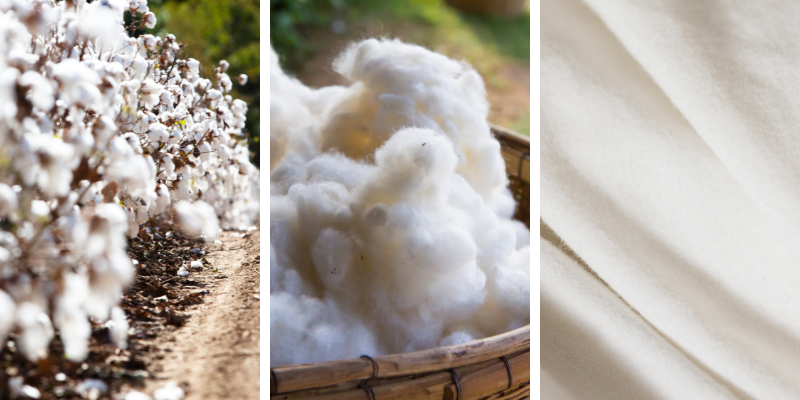
How to obtain brushed cotton?
In our last article on cotton, we already noted that cotton is the most used natural fiber in the world. And for good reason, cotton has many advantages. In addition to its hypoallergenic qualities, cotton is a fiber that can be transformed into a beautiful variety of fabrics with aspects as diverse as silky and smooth cotton poplin to soft and fluffy cotton flannel. Have you ever heard of brushed cotton? Combed cotton? Carded cotton? Today, we highlight the different stages of cotton transformation, from harvesting to brushing, so that these different terms no longer have any secrets for you.
.png)
We know that the cotton plant is greedy for water and sun. During its growth, it needs about 120 days of abundant rain to thrive. Then, during its maturation, it needs sun, heat and dryness, otherwise, its fruits will rot. The areas most naturally suited to cotton cultivation are therefore subtropical and tropical with alternating seasons. Other climate zones must compensate for the lack of rain through irrigation.
(1).png)
It's during summer that the shrub enters into bloom. Once summer has passed, the delicate white flowers will have faded, giving way to the fruit. It's only when this "capsule" that has enclosed and protected seeds and white fibers has completely dried that cotton is harvested mechanically or by hand.
(2).png)
The harvested cotton boll therefore contains fibers and seeds. The first step in cotton processing after harvest then consists of separating the two. The seeds are used for livestock feed or transformed into vegetable oil. Used as cooking oil in Africa or Central Asia, it mainly finds its place in cosmetics.
(3).png)
This step actually consists of untangling then aerating the cotton fibers in their raw state. Indeed, during harvesting, impurities such as dried leaves and petals remain attached to the cotton bolls. So once separated from its seeds, the boll is roughly untangled to get rid of them, then enclosed in standardized 500 kg bales.

These cotton bales are then purchased by spinning mills which, depending on their ambitions regarding this material, proceed to additional processing steps such as combing. This step consists of properly combing the cotton fibers to keep only the longest and therefore most qualitative ones. Once passed through the combing machine, the remaining fibers will therefore be the longest, but also the silkiest and most brilliant.

The cotton ribbons are mechanically twisted and spun into bobbins. If two cotton threads have been twisted together, it's called a two-ply thread, providing more strength. It's usually after this step that the thread is dyed. This way, the colors adhere better and don't fade when washing the final product.

Weaving is the stage where everything takes shape: plain, twill or satin weave, solid or patterned, it's the weaver who has the threads in hand. The weave, we remind you, is the way the warp and weft threads are interwoven. In the case of oxford fabric, for example, it's a plain weave whose warp and weft threads have been doubled or chosen with different counts. Often, undyed threads are used for the weft and colored threads for the warp to give a slightly grained or checkered appearance to the fabric.

Let's stick with our example: this beautiful oxford fabric could very well remain as is. But for a fluffy appearance and softness similar to your favorite fleece sweatshirt, the fabric will go through one last step before being entrusted to the manufacturer: brushing. Mechanically brushed on one or both sides, we thus obtain an oxford in brushed cotton, ultra-soft with a casual look.
(9).png)
You will have understood,brushed cotton, brushed cotton or even cotton flannel, it's actually a cotton fabric whose surface has been brushed for a soft and fluffy appearance.