


The twenty-nine stages of this manufacture are carried out by craftsmen in two factories renowned for their expertise, in Gaillard (France, since 1919) and Como (Italy, since 1931). The same seamstress performs all the steps, from cutting the fabric into a square of silk 70 cm by 70 cm – essential to the proper shape of the tie – to sewing the final stitch-point that requires turning the thread eighteen times around the needle, not one time more and not one time less.
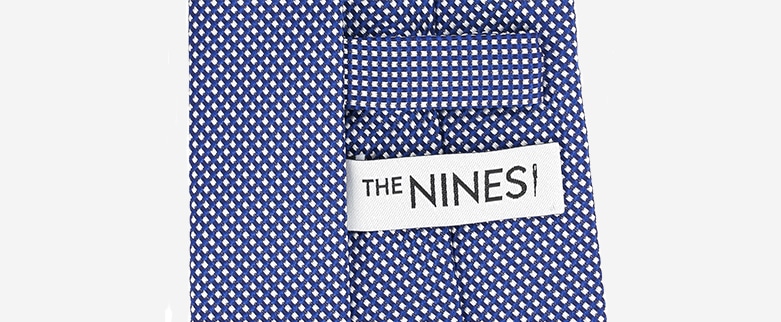
All our silks and fabrics are subject to a rigorous selection process which allows us to offer you top quality. They are woven only in countries with a strong tradition of weaving: France, Italy and Switzerland. Our weavers supply several of the biggest fashion houses. For example, we use among others the famous Weisbrod silks, woven since 1825 in Zurich by the same process.

The selection of the fabric
A tie is characterised by the quality and beauty of its fabric, which is why it is essential to carefully select a fabric that will bring strength and suppleness to the tie. Our fabrics come from the best weaving workshops and from countries known for their tradition of weaving, like France, Italy and Switzerland. Moreover, our weavers also supply the biggest fashion houses.
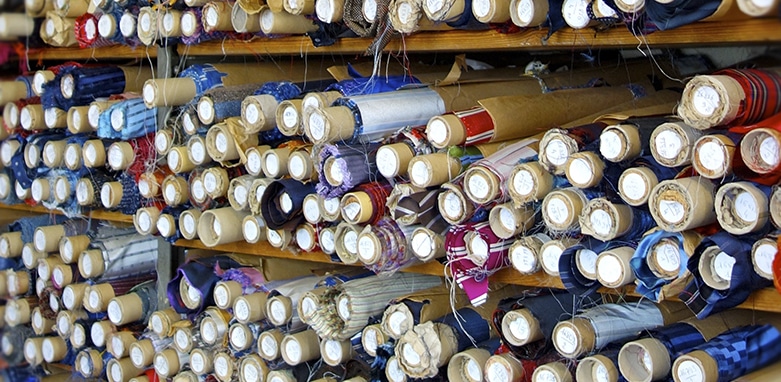
An extensive collection of fabrics for varied and elegant ties.

Drawing and cutting of the template
Once selected, the template is drawn and fabric is cut using a software program at the cutting edge of the latest technology: CAM / CAD. This software helps achieve uniformity in the cutting as well as the organised and intelligent design of each piece of cloth.
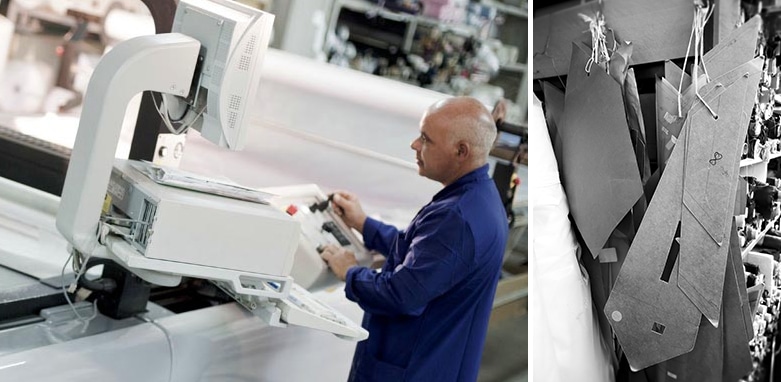
Drawing and cutting the tie template
However, several of the patterns, specific tissues and assembly techniques require the expertise and professionalism of the craftsmen in our workshops, who have mastery of the methods of traditional tailoring.
In both cases, attention is paid to the quality of the cut which must be uniform, precise and without interruption for each fabric and pattern.
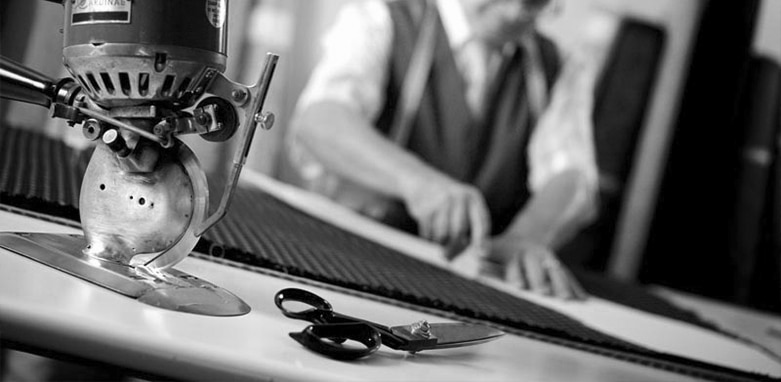
Precision cutting of the fabric to ensure the regular fall of the tie.
The cutting of the lining of the tie.
This step is one of the most important stages in the manufacture of the tie. The lining forms the basis of the general shape and stiffness of the tie. To perform this step, we use CAM / CAD software again, which brings precision and perfect symmetry to the tie. With this method, the lining can be placed precisely on the fabric of the tie.
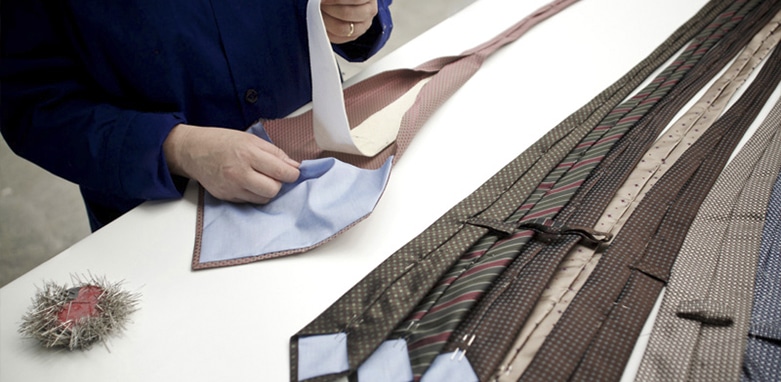
Cutting the lining of the tie.
Sewing the lining of the tie.
Once cut, the lining is sewn on the inside of the tie so as to establish a merging and perfect alignment of the two fabrics.
Using an ironing press, the ends of the tie are folded and ironed evenly so that the tie is symmetrical, straight and smooth.
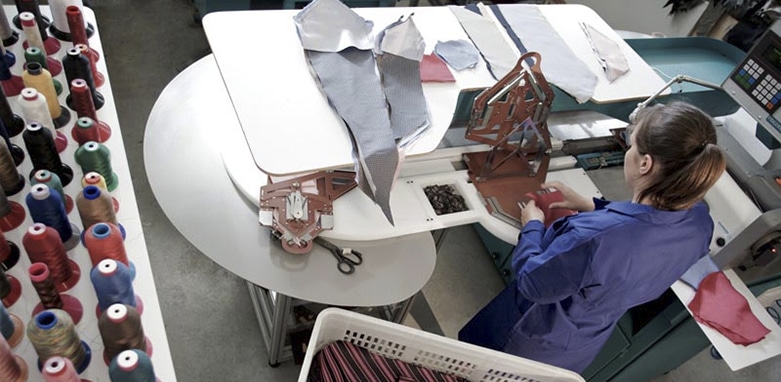
Sewing the lining of the tie.
Sewing the hem and the tip of the tie.
Having pinned the tie, our craftsmen proceed to sew the hem and the end of it. This step is crucial for the quality of the tie! Therefore it is our artisans who hand-sew the ends symmetrically by checking the adjustment of the stabiliser.
Now it's time to finish the tie! The skilled hands of our tailors ensure the finishing of our ties by stitching the points. These stitch-points fix the silk to the lining of the tie, forming a discreet little loop. Thus the flexibility of the tie is guaranteed.
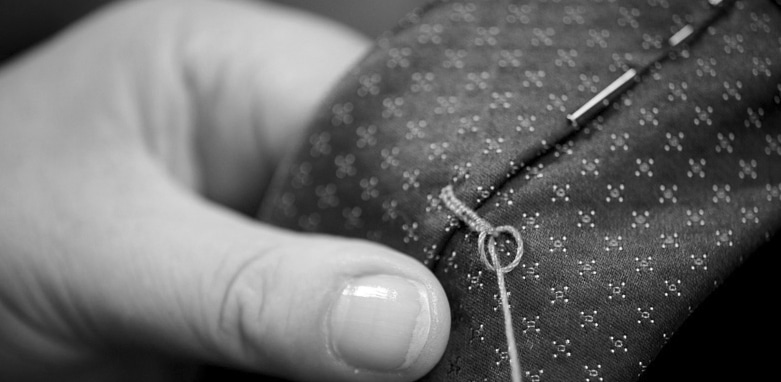
Hand-sewing the finishing-loop.
In a continuing effort to offer the highest quality to our customers, our ties are subject to a final inspection. We ensure that the width and length are perfect. After this step, a final touch is given to the tie using the iron.
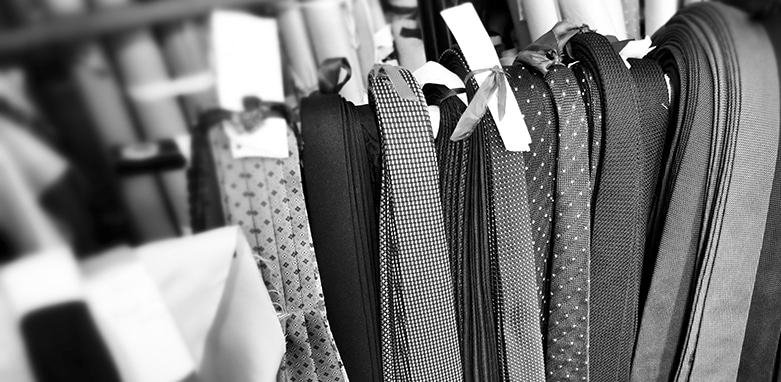
To ensure the highest quality, we carry out two complete cycles of quality control.