


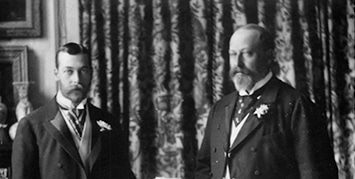
The Ascot tie appeared at the end of the 19th century. It became famous in 1880 when King Edward VII wore it at the famous Ascot Gold Cup racecourse which takes place at the Ascot village.
Since then it has become an incontrovertible accessory of this event and is henceforth worn on official ceremonies such as weddings. The Ascot tie possesses two ends of the same length and is usually tied like an ordinary tie by forming three plaits round the neck, once tied.
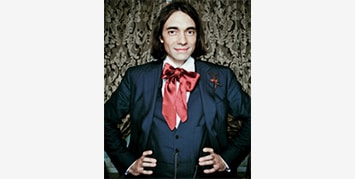
Caution not to confuse the ascot tie with the floppy neck-tie! The floppy neck-tie was originally a woman's scarf which goes back to the duchess of La Vallière, one of Louis XIV's mistresses.
Less long on the neck than the Ascot tie, its shape is closer to the tied bow tie with two buckles and two pending ribbons.

To do this knot you need to place the longer end on your left and the shorter one on your right.
1 -Place the longer end lower than the short one. The first seam of the long end needs to be placed at the level of your second shirt button.
2 - Pass the longer end over the shorter end and then underneath it.
3 - Place the longer end over the beginning of the knot. You have now done a first turn.
4 - Now take the longer end out again by passing it behind the knot.
5 - Slip the longer end inside the knot and adjust.

To tie this knot you need to place the two ends at the same level.
1 - Place the left end over the right end.
2 and 3 - Now you need to form a knot. Therefor pass the left end underneath the crossbreeding which you've just formed and then pass it over.
4 - Fold the left end horizontally.
5 - Pass the right end (which is now underneath) through the previously formed buckle. You have now formed a second knot.
6 - Puff up the knot and shape some cruciform effect by placing the two ends over the knot.

Your floppy neck-tie has two ends of the same width. However, on this one, one end is slightly shorter than the other. Place the longer end on your left and the shorter one on your right.
1 - Place the long end lower than the short one. The first seam of the long one needs to be at the level of the second button of your shirt.
2 - Pass the longer end over the shorter one and then underneath it.
3 - Place the longer end over the beginning of the knot. You have now done a first turn.
4 - Take the longer end out by passing it behind the knot.
5 - Let your ascot hang over the knot. Adjust.
the floppy neck-tie needs to be worn necessarily with a white or ivory coloured Ascot wing collar shirt, not to be confused with bow tie wing collar shirt. Actually, the floppy neck-tie needs a larger shirt collar than the bow tie. The three-piece suit with jacket is strongly recommended as an elegant outfit for official ceremonies like the wedding. The floppy neck-tie can match the jacket, in general grey or black or be of the wedding's theme colour.
There are also less formal ways of wearing a floppy neck-tie with the «half-ruche» knot. Indeed, with the return of the dandysm the floppy neck-tie is more and more worn directely around the neck underneath the shirt.
If that's the case the choice of the floppy neck-tie and the shirt are completely free. In fact, contrary to the other two knots, the Ascot wing collar shirt is not necessary. You can also play on the contrasts of colours and patterns. This knot can also be realized with equal result on a scarf.
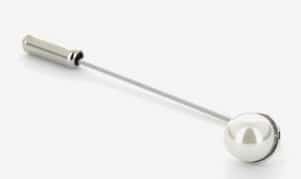
Originally this accessory was worn by english aristocrats of the 18th century to avoid plaits on the tie. The tie-pin was made to measure and topped by a pearl or a gemstone.
If you choose to wear a suit with a jacket the tie-pin is worn five centimeters over the first button. Without a jacket you can wear it lower but in any case in the first third of your tie. Beware of fashion faux pas!